Beyond the Fastest Route — Context-Aware Automotive HMI Prototype
A browser prototype where a panoramic driver display and central IVI share one state system, planning an EV family journey around people, weather and driver attention—not just range and charging.
Why this exists
Vehicle interfaces have become very good at optimizing routes — time, traffic, energy, charging. A family journey is a different problem. It includes food, rest, restrooms, play, changing weather and a driver whose attention is not always available. Most current interfaces treat these human factors as secondary, and they use the same touch-first interaction model whether the car is parked or moving at 110 km/h.
> Vehicle interfaces understand the route — but not the life happening around it.
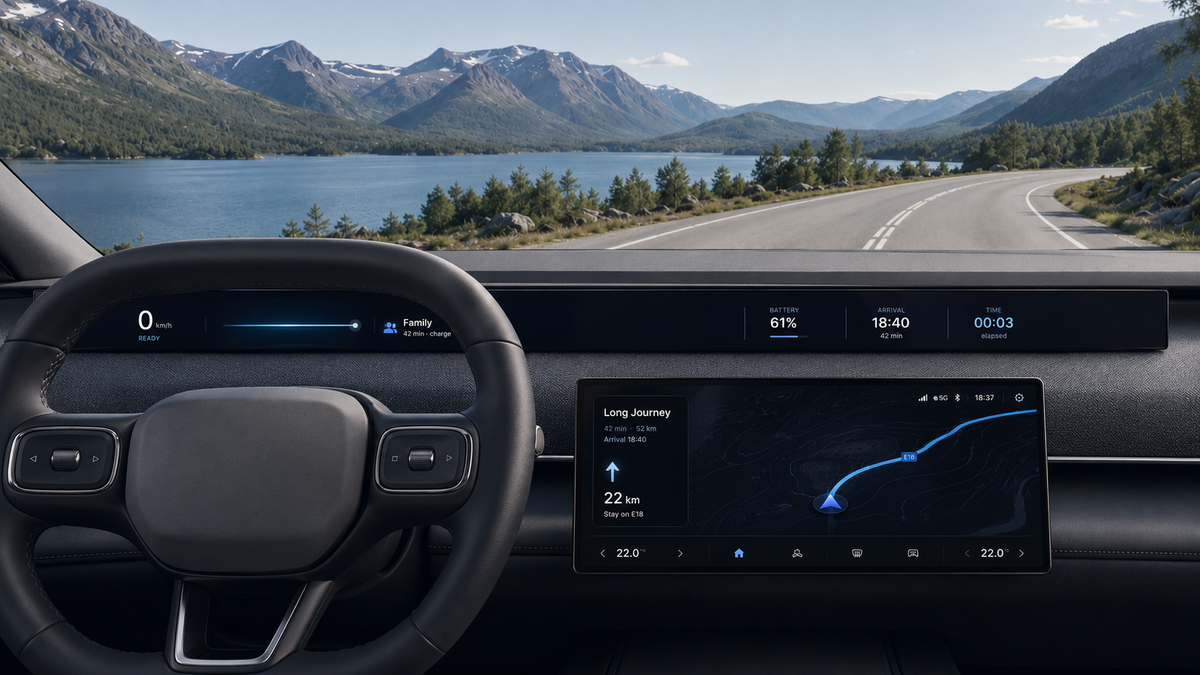
Contextual Journey HMI is a browser-based behaviour prototype built to explore a different approach: two connected display surfaces — a panoramic driver display and a central IVI — driven by a single scenario and vehicle-state engine. When the car is parked, the IVI opens up for planning and comparison. When the car moves, information density drops, critical driving data shifts to the panoramic display, and non-urgent suggestions wait.
*This is a self-initiated fictional concept created to explore context-aware automotive HMI behaviour. It is not affiliated with any employer, vehicle manufacturer or proprietary production system. Vehicle, journey, attention and personalisation data are simulated.*
The hypothesis
The project deliberately steps out of the "touchscreens vs. physical buttons" debate. Neither is the answer on its own; each interaction mode is right in a different situation. Rich touch works when the car is parked. Glanceable information works while driving. Fixed physical controls work for critical, frequent functions. Voice works for simple, unambiguous commands.
> The future is not buttonless. It is modality-aware.
Every suggestion in the system passes through the same decision chain before it reaches a screen: **Context** — what is happening in the journey right now? **Relevance** — is there genuinely useful help to offer? **Timing** — is this the right moment? **Modality** — which surface and interaction mode fit? **Consent** — has the user explicitly approved the change? **Adaptation** — how do the journey and both displays update? **Explanation** — can the system say, briefly, why it suggested this?
And one principle above all: **silence is a valid output.** Having data does not mean showing a card.
The prototype below is the actual system, not a video. Select a guided scenario, or open the System Explorer to change speed, battery, weather, occupants and attention states directly.
One journey, told through states
Two adults and a child prepare for a 420 km EV trip, starting at 85% battery. A conventional planner computes the fastest route and the most efficient charging stops. This system compares two answers to the same question: the fastest route, and a family-balanced route that groups charging, food, clean restrooms and a playground into a single stop — roughly 11 minutes slower, four human needs solved at once.
**Departure.** As the vehicle shifts from PARKED to DRIVING, the IVI closes its planning detail and the panoramic display takes over speed, navigation and battery.
**Focused driving.** The system's most important behaviour is doing nothing. While the driver is engaged with the road, no new suggestions appear. The IVI holds a calm route view; the panoramic display shows only what driving requires.
Focused driving — reduced information density, no suggestions.
**The family stop.** At the right moment, one card: *"In 42 minutes, there is a charging stop with food, clean restrooms and a playground. It adds 11 minutes compared with the fastest charging route."* One clear decision, an honest cost, and a visible reason.
**Child resting.** The simulated journey context reports that the child is asleep. The system offers to move the stop 35 minutes later without breaking the charging plan. There is no camera and no emotion detection here — this is a simulated context state, and the prototype labels it as such.
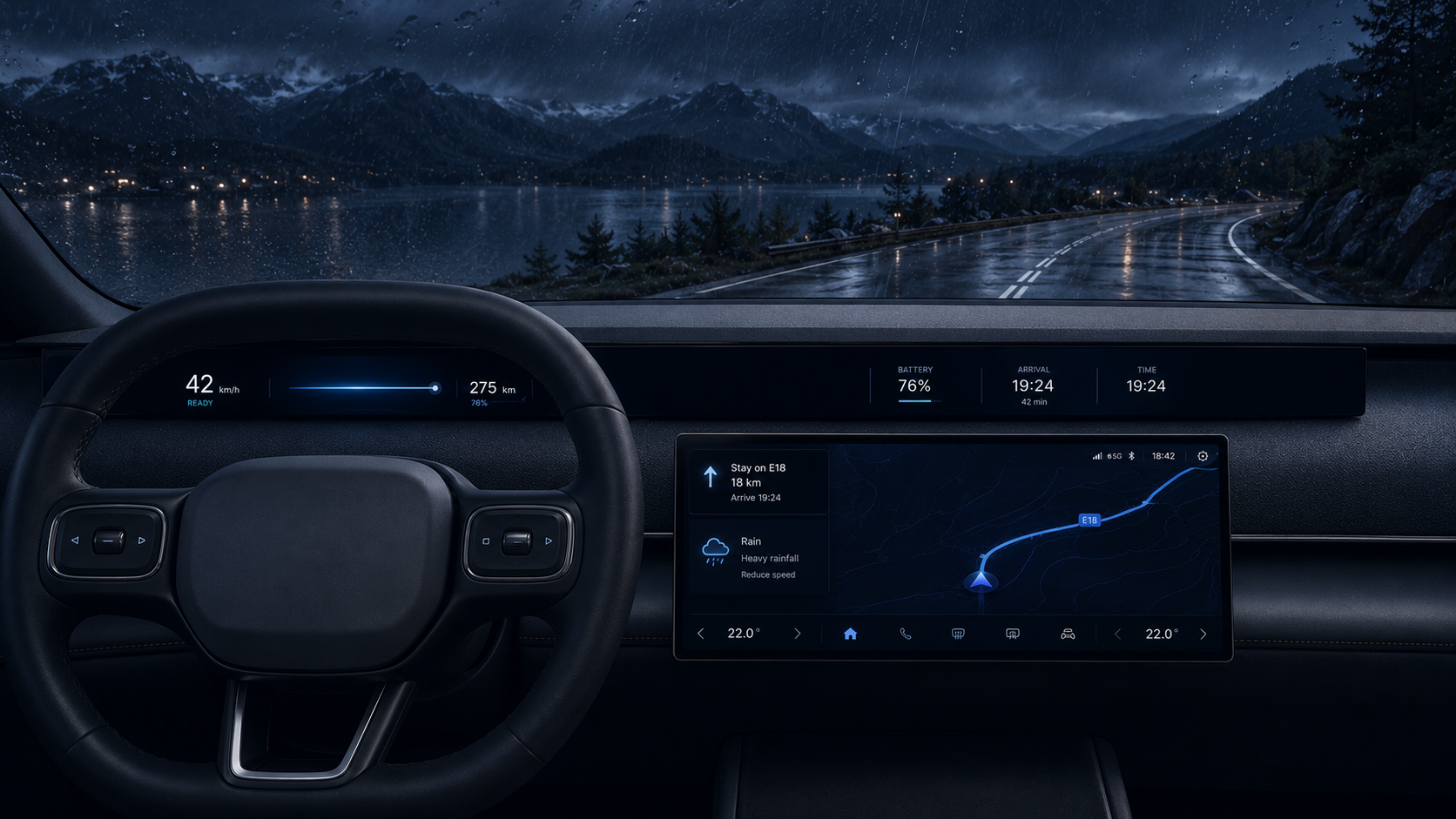
**Rain.** Weather data indicates rain will reach the outdoor stop before the family does. A covered family area, 8 minutes off route, is offered as an alternative. Nothing changes without explicit consent; declining keeps the original plan intact.
Connected display behaviour
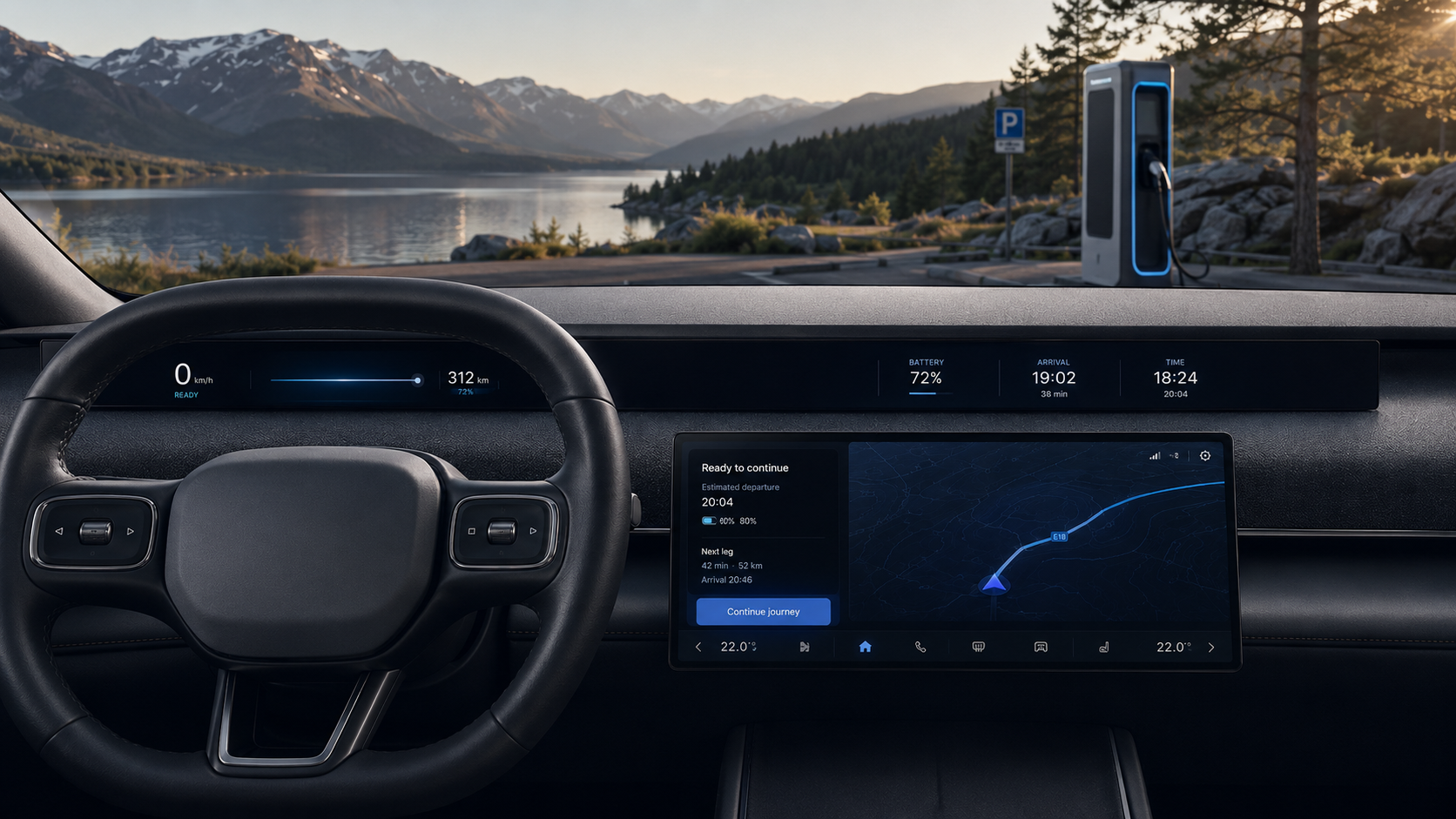
The two screens are not independent mockups. Both read from the same state system, and each state defines who says what:
**Parked setup** — the panoramic display holds a journey summary; the IVI carries rich planning and route comparison. **Focused driving** — speed, navigation and battery up front; a quiet route view below, no suggestions. **Family stop** — a short contextual prompt above; a single meaningful decision with its rationale below. **Rain adaptation** — a brief weather warning above; a current-vs-covered comparison below. **Arrival** — charging and rest status above; rich stop detail and next-leg timing below.
Beyond the long journey
Two supporting scenarios test the same logic at smaller scale. **Weekday Rhythm:** *"Your usual bakery adds 6 minutes this morning."* A routine suggestion that explains itself, offers a clear yes/no, and never asks the driver to dig through menus while moving. **Weekend Discovery:** instead of hundreds of map pins, two curated family options — and when rain approaches, a covered alternative that still waits for consent before changing the destination.
## What this is not
This is a behaviour prototype, not a product. Attention states are simulated — there is no camera or driver-monitoring hardware. The recommendation logic is rule-based, not a learned personalisation model. Journey, map and weather data are fictional. No user testing has been run yet, and nothing here is a production or safety-validated system.
The next steps are validation, not features: task-completion and comprehension tests with different drivers, a parked-vs-driving information density comparison, recommendation timing studies, and an honest look at where contextual help starts to feel like surveillance.
*Self-initiated fictional concept. Not affiliated with any employer, vehicle manufacturer or proprietary production system. Design principles were studied from publicly visible industry directions (panoramic displays, calm information hierarchies); no OEM geometry, iconography, typography or interaction patterns were reproduced.*