Digital Twin User Clinics — Testing Unbuilt Vehicles in Unreal Engine
A user clinic for a vehicle that hadn't been built: every moving function of the design and every movement of the user mirrored 1:1 in an Unreal Engine digital twin.
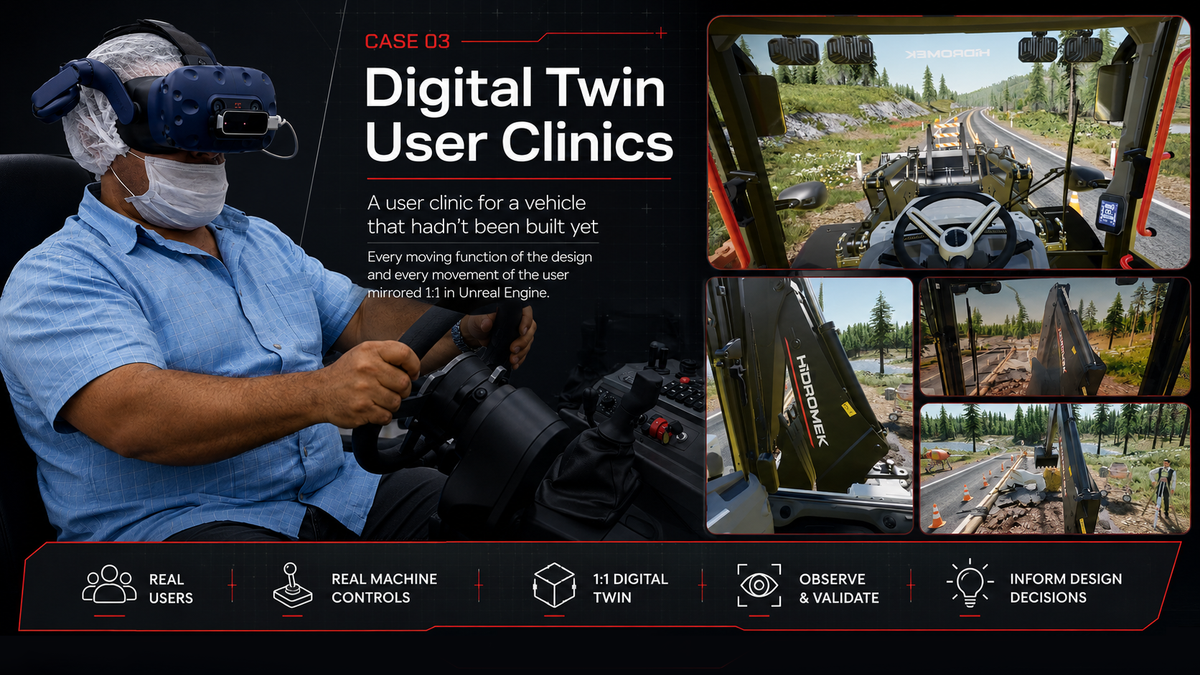
Somewhere in every vehicle programme there is a stretch where the most expensive questions have no object to point at. The design exists — surfaces, package, controls — but nothing anyone can sit in. Does a control fall naturally to hand? Does the working posture survive a full shift? Does a seat rotation mid-task feel right? Renders don't answer these questions, and physical prototypes answer them late, at prototype prices.
We answered them early. At the Hidromek Design Studio I built a functional digital twin of a vehicle that hadn't been built yet, and we ran user clinics on it: real users, real task cycles, on a design that existed only as data. I was the sole developer of the entire instrument — the twin, the physical rig around it, and the software binding the two.
How do you run a user clinic for a vehicle that doesn't exist?
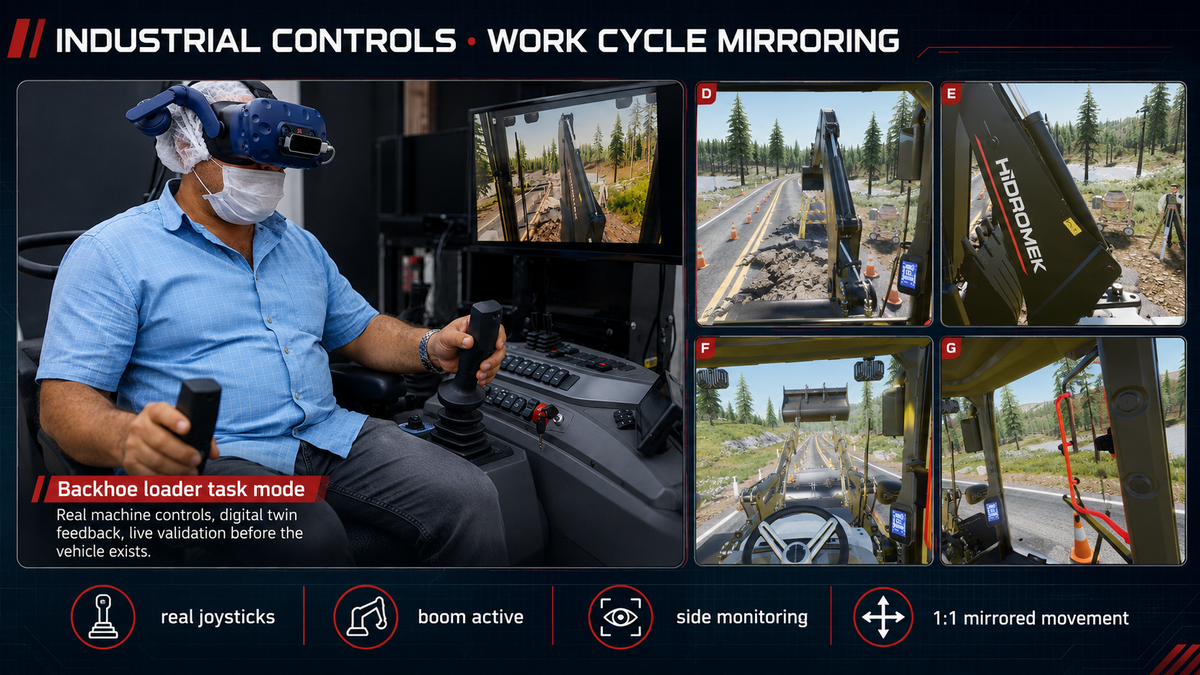
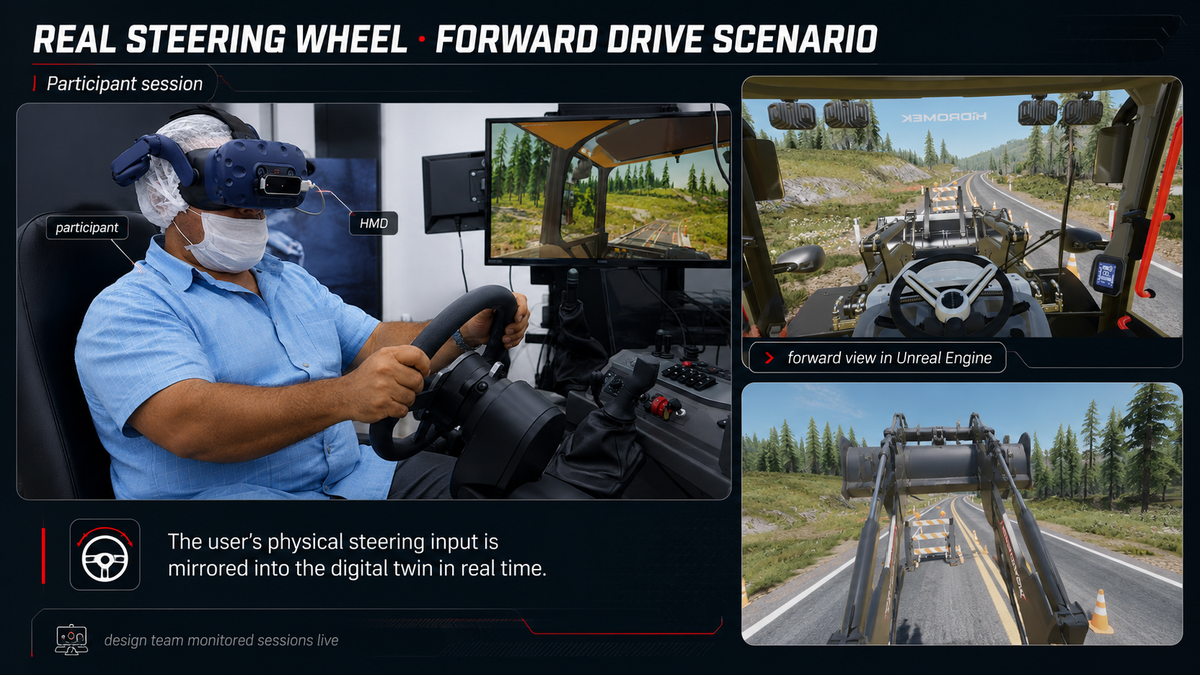
Two rules, both absolute. First: every moving function of the design is in the twin — steering, seat rotation, work functions, controls — replicated one-to-one from the design data, not approximated. Second: every movement the user makes is transferred one-to-one back into the twin. The steering wheel and the rotating seat in the room are real, their motion read by sensors and mirrored exactly; hands are tracked at finger level; the vehicle's functions run on the same class of controls the job actually uses. A headset closes the loop between the user's eyes and the twin.
Both rules exist for one reason: the moment what the body does and what the eyes see disagree, participants stop behaving naturally — and from that moment on, the data means nothing. Fidelity isn't polish here. It's validity.
A clinic session: real steering wheel, rotating seat, industrial controls — the design team watching the participant's view live.
Sessions ran with experienced operators of this vehicle class — pandemic masks and all — on task cycles taken from the job itself, in a scenario built for the study. The design team followed each session live on an observer monitor showing exactly what the participant saw. The clinic's output wasn't opinion collected afterwards; it was behaviour, watched and measured while the design could still change.
The participant's view: the twin's cab and work cycle, every moving function live.
The vehicle in this clinic happened to be a construction machine, because that is where I was. Nothing in the method cares. The same instrument runs a truck cab, a passenger-car interior — any product whose experience has to be judged before the object exists. The expensive part is built once: one-to-one functions, one-to-one movement. After that, the twin changes and the clinic stays.
Role & credits. The digital twin, the physical rig, the sensor and hand-tracking integration, and the clinic software: Kadir Özkan, sole developer. Vehicle design: Hidromek Design Studio. Machine engineering: Hidromek.
Three projects, one boundary. Opera connected a station to a real machine over a network. The VRL simulation put real controls on a machine that existed only in the engine. This clinic completed the triangle: the human, measured against a design before it became an object. Different directions across the same line — physical product and real-time software, treated as one system.